C o u r s e _ D e s c r i p t i o n s
Introductory Seminar: Detailed Outline
What will I Learn?
In this 6 day, hands on training you will learn about all aspects of Live Cell Microscopy including:
•An introduction to the blood cell system and its vital role in overall health
•How to interpret live under the darkfield microscope live and dry blood cell samples
•How to incorporate live cell microscopy into your own practice
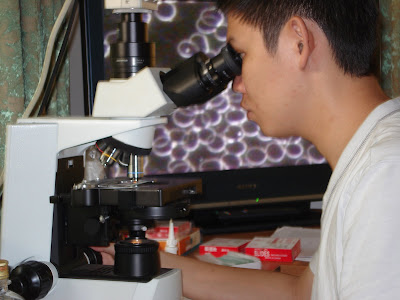
•How to operate a dark field microscope? getting practical experience in the course
•Understand and see the principals of pleomorphism http://www.dreddyclinic.com/forum/viewtopic.php?f=6&t=19576
•Capillary puncture training, tips and tricks
•Accurate methods of obtaining live and dry blood cell samples
•How to assess your findings and make effective health recommendations
I.
The Four Underlying Causes of Illness and What To Do About Them
A.
Trauma is the cause of all illness
1.
Trauma is generated through the effects of emotional and environmental stressors
2.
Our inability to either shield ourselves from them or transcend our negative reactions to them
B.
Review of Evaluation Form
C.
The Four Underlying of Causes related to illness
1.
Chemicals
a.
Endogenous sources
b.
Exogenous sources
c.
Environmental
d.
Dietary
e.
Self-generated (endocrine/stress chemistries)
2.
Diet
a.
The four food groups
b.
Processed, junk, fast, nuked
c.
Indigestible, unassimilable, difficult to eliminate
d.
Stimulants, sugar, alcohol
e.
Poor food combining
f.
Excess animal protein
g.
Overeating
h.
Enxymatic depletion
3.
Radiation
a.
ELF/EMF
b.
Nuclear
c.
Radon
d.
UV
e.
X-Ray
f.
Scalar
g.
Cosmic
4.
Emotion
a.
Unmitigated Chronic Stress
b.
Addictions
c.
Unresolved emotional/sexual conflicts and early-life traumas (i.e., abuse)
d.
Life-style problems
e.
Inability to transcend the negative effects of fear, sorrow and anger (chronic reactive emotions)
D.
pH and Oxygenation
1.
pH and Oxygenation are effected by:
a.
Chronic stress
b.
Lack of exercise
c.
Poor circulation
d.
Chronic infection
e.
Mental attitude/emotional disposition
f.
Poor diet
g.
Environmental factors
II.
The life cycles of symbiotic microorganisms
A.
How to use the manual and worksheets
B.
Introducing Professor Dr. Gunther Enderlein
1.
Pleomorphism - The Lifecycle of Mucor Racemosus Fresen
2.
Blood Pictures
3.
Review of Blood Forms
4.
Application of SANUM Remedies
C.
Vocabulary
1.
RBC
2.
WBC
3.
Endobiosis
4.
Dysbiosis
5.
Colloid
6.
Protit
7.
Thrombocyte
8.
Filit
D.
Dr. Gunther Enderlein - Born July 7, 1872 / Died 1969
1.
The fundamental tenets of Pleomorphism per Enderlein
a.
The cell is not the smallest visible living organism, but rather the colloid
b.
Bacteria have a nucleus or nucleic equivalent
c.
Proof of the sexual propagation of bacteria
d.
The scientific proof of pleomorphism in microbes
e.
The proof that there is no sterile, germ-free blood
f.
Disease means symbiotic disturbance, or Dysbiosis
g.
Certain microorganisms undergo an exact, scientifically verifiable growth cycle (cyclogeny)
h.
Normally apathogenic microorganisms can progress into disease related, toxic phases of development
i.
That progression is dependent on the terrain
j.
Each transition through a single cyclogenic phase of development progresses in leaps and is known as a cyclode
k.
Pathogenic microbes can be reverted to their lowest, primitive developmental stage, which can then be excreted by the body
l.
The stages are the primitive phase/bacterial phase and fungal phase
m.
Pathogenicity is the viral phase which may occur at any point in the development
n.
The Life Cycle of Mucor racemosus Fresen, The Endobiont (see the manual, lesson II)
I.
The Endobiont, Mucor racemosus Fresen
1.
There are, of the millions of microbes, only two that should be considered to be a constant companion in the human body (and all mammals)
a.
They are Mucor racemosus Fresen and Aspergillus niger van Teighem, the two primary parasites
b.
They are present in all phases of development of the body and are present in every cell with a developed symbiosis
c.
Mucor is transformed, through excessive animal protein, sugars, and other acidifying factors into the worst kind of parasite. It has a congestive effect causing circulatory hindrance and subsequent underoxygenation of the tissues and cells, leading to cancer, heart disease and strokes.
J.
Aspergillus niger van Teighem
1.
The second primary parasite
2.
Considered to be the second leg of one degenerative process, with one leg always being predominant
3.
The working method of Aspergillus is the misdirection of biological processes.
4.
Aspergillus is related to tuberculin and paratuberculin disorders, (generally, breakdown of the body rather than congestion)
5.
In degenerative disease conditions, both are always addressed therapeutically
K.
Early Chondrit phases
1.
Protits are living albumic colloids which are achro chromatic (not stainable)
2.
There are approximately 0.01 microns, invisible by light microscopy, entirely non-virulent and regula tory. They are observable under some conditions as a veil or haze over the microscopic field.
3.
The protit regulates through copulation with the mutagenic forms (information sharing, per Dr. Enderlein)
4.
A communization of protits occurs in three ways
a.
A one dimensional line becoming a thread (filum) with a diameter the size of the protit, becoming stronger and thicker as it is formed
b.
Two dimensional arrangement of protits or spermit. Protit head and filum.
c.
Three dimensional arrangement, the symprotit. Tiny grainlets or clusters of symprotits and nutritional reserves.
d.
All higher developmental phases represents a nationalization of all previously developed forms.
L.
Advanced Developmental Phases
1.
The protits and symprotits are the "bricks"
2.
The further developmental phases are the "buildings" which are constructed of them.
3.
Similar to architecture, the "buildings" have different functions
M.
pH as related to the Cyclogeny
1.
The endobiont is very specifically a protein devourer, particularly animal proteins. Excess accumula tions of proteins as unassimilated nucleic acids create an acidic milieu in the tissues.
2.
The pH of the blood is shifted through the activity of the endobiont (through acidification of the tissues and subsequent alkalization of the blood)
3.
Progression from the protit stage to the colloid stage is dependent on the pH value progressively descending
4.
Each microbe produces a purely organic acid which is species specific in nature:
5.
Aspergillus niger van Teighem - citric acid
6.
Penicillium Notatum West - penicillic acid
7.
Mucor Racemosus Fresen - lactic acid
8.
Otto Warburg, twice Nobel prize winner in medicine
a.
Reports that all cancer tumors form lactic acid
b.
The human organism is incapable of this without the entire developmental stages of the endobiont
c.
Discovers that lack of O2 and subsequent fermentation are related to all cancers.
9.
It is not possible to force a developmental rise by enriching the acidity of the nutritive medium, even using the Microorganism specific acid.
10.
It is possible to create a descending developmental tendency into the lowest forms through alkaliza- tion, whereby the chondrit stage is immediately observed.
11.
Phases in the life-cycles of pleomorphic microorganisms progress in developmental "leaps" which are pH dependent.
III.
The Heitan/LeGarde Test
A.
Oxidative Stress/PPP's
B.
Reading the rings
C.
Reading the layers
IV.
Requirements for Dry Blood Analysis
A.
Low magnification, 2.5X to 4X objective with optional 10X objective
B.
Low intensity illumination sources from reflected light, direct light, or fluorescent, tungsten or halogen bulbs
C.
Monocular, Binocular, or Trinocular Microscope
Comprehensive interactive Live Blood Course CD:
http://live-blood.blogspot.com/2007/11/comprehensive-interactive-cd-course-of.html
more information about the Live Blood Darkfield Analysis Course:
pleomorphism, pleomorphic, what is pleomorphism
http://www.dreddyclinic.com/education/live_blood_3days.php
http://www.dreddyclinic.com/education/live_blood_3days.htm#Live_Blood_Analysis_online_correspondence_course0
and you can fill out and subsribe here:
http://www.dreddyclinic.com/online_recources/LBA_Courses_Application.pdf
http://live-blood.blogspot.com
Some of our students for the dark field microscopy live blood course you can visit here:
http://www.dreddyclinic.com/forum/viewtopic.php?f=6&t=12470
More information about pH and alkaline concept:
http://www.dreddyclinic.com/diet/alcaline/alk_diet.php
http://www.dreddy-clinic.com
http://www.dreddyclinic.com/online_recources/articles/treatment/introd_pH.htm
http://en.wikipedia.org/wiki/Live_blood_analysis
Read more

